
The digital world has reached a turning point. For years, businesses have focused on attracting human visitors through search engines, social media, and online advertising. However, the rise of artificial intelligence has introduced a new audience that many brands never considered – AI-powered bots and intelligent agents.
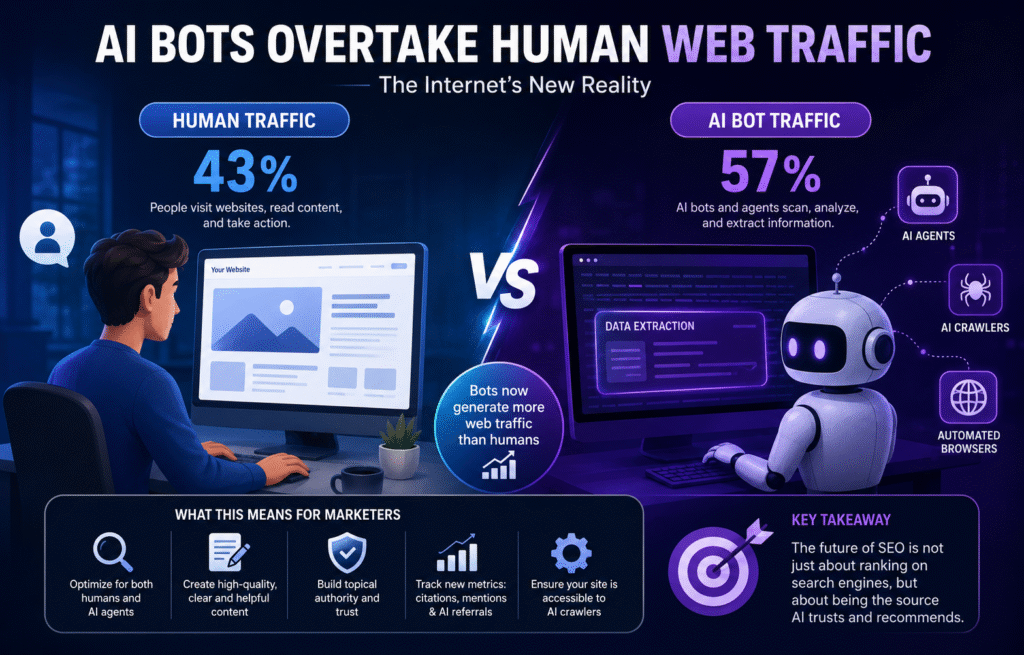
Today, websites are no longer visited only by people. AI assistants, automated browsers, search crawlers, and intelligent software are now exploring the web at an unprecedented rate. Recent industry reports suggest that automated traffic has overtaken human-generated web traffic for the first time, signalling a significant change in how the internet operates.
For marketers, business owners, SEO professionals, and website managers, this isn’t simply another technology trend. It’s a major shift that requires a fresh approach to online visibility.
In this guide, we’ll explore why AI bots, web traffic, and AI SEO have become central to modern digital marketing, what this means for businesses, and how you can prepare your website for both human visitors and intelligent AI agents.
The Internet Is Changing Faster Than Ever
For decades, websites were designed with one goal in mind: providing information to people.
Everything from website design to content creation revolved around improving the user experience. Businesses monitored metrics such as:
- Page views
- Session duration
- Bounce rate
- Click-through rate
- Conversion rate
These measurements helped determine whether a website was performing well.
However, artificial intelligence has introduced a completely different type of visitor.
Modern AI systems don’t browse websites like humans. Instead, they scan pages, analyse information, compare sources, summarise content, and present answers directly to users without necessarily generating traditional website visits.
This evolution means businesses now need to optimise their websites for two audiences:
- Human readers
- AI-powered systems
Ignoring either audience could reduce your online visibility over time.
AI Bots Are Becoming the Internet’s New Audience
Artificial intelligence bots are far more advanced than traditional search engine crawlers.
Instead of simply indexing pages, many AI agents now attempt to understand:
- Context
- Expertise
- Accuracy
- Authority
- Relationships between topics
- Trustworthiness of sources
When someone asks an AI assistant a question, it may gather information from multiple websites before generating a response.
If your website becomes one of those trusted sources, your brand gains exposure even if the user never performs a conventional Google search.
That makes AI bots increasingly valuable visitors.
Why Traditional SEO Alone Isn’t Enough
Search engine optimisation remains incredibly important.
However, traditional SEO primarily focuses on improving rankings within search engines.
AI search introduces additional challenges.
Businesses now need content that AI systems can easily:
- Read
- Interpret
- Verify
- Reference
- Quote
- Recommend
Instead of chasing rankings alone, websites should aim to become trusted sources of information.
This shift represents one of the biggest changes SEO has experienced in years.
Understanding AI SEO
The phrase AI SEO has become increasingly common.
It refers to optimising websites not only for search engines but also for AI-powered assistants and large language models.
Rather than simply targeting keywords, AI SEO focuses on creating information that machines can confidently understand and reference.
Some important characteristics include:
- Well-structured headings
- Clear explanations
- Accurate facts
- Natural language
- Helpful answers
- Strong topical authority
The easier your content is for AI systems to interpret, the greater your chances of being included in AI-generated responses.
Why Website Authority Matters More Than Ever
Artificial intelligence doesn’t simply select random websites.
Instead, it attempts to identify trustworthy sources.
Authority is built through:
- High-quality content
- Consistent publishing
- Reliable information
- Expert knowledge
- Strong backlinks
- Positive brand reputation
As AI becomes smarter, these trust signals become increasingly valuable.
Businesses investing in genuine expertise are likely to outperform those relying on outdated SEO shortcuts.
The Rise of AI Search
Traditional search engines display lists of links.
AI search often delivers complete answers.
For users, this creates a faster experience.
For businesses, however, it changes how visibility is measured.
Instead of asking:
“How many visitors came from Google?”
Marketers increasingly ask:
- Did AI mention our brand?
- Was our content cited?
- Which pages were referenced?
- How often are AI assistants recommending us?
These new measurements may soon become as important as traditional rankings.
Content Quality Has Never Been More Important
Artificial intelligence rewards useful information.
Thin content written only to target keywords offers little long-term value.
Instead, successful websites now focus on:
- Solving real problems
- Answering genuine questions
- Providing expert guidance
- Explaining complex topics clearly
- Updating outdated information
High-quality content naturally performs well for both humans and AI systems.
Why Web Traffic Metrics Are Changing
For years, marketers celebrated increases in web traffic.
More visitors generally meant more opportunities for sales.
But AI-generated answers are changing this relationship.
A person may receive an answer directly from an AI assistant without ever clicking a website.
That doesn’t necessarily mean your content failed.
If the AI referenced your expertise, your brand still gained visibility.
As a result, businesses should begin monitoring additional performance indicators beyond page visits.
New Metrics Every Marketer Should Watch
Future digital marketing reports may include measurements such as:
Citation frequency
How often AI systems reference your content.
AI brand mentions
How frequently your business appears in AI-generated answers.
AI referral traffic
Visitors arriving from AI-powered platforms.
Content authority
How consistently your website becomes a trusted information source.
Topic coverage
Whether your website comprehensively answers user questions.
These metrics provide a broader picture of online visibility.
Building Content That AI Bots Prefer
AI systems reward clarity.
Consider these best practices when creating content.
Use clear headings
Well-organised articles are easier to interpret.
Answer questions directly
Provide concise, accurate answers before expanding into detail.
Cover topics thoroughly
Complete guides often perform better than shallow articles.
Avoid unnecessary repetition
Keyword stuffing reduces readability.
Keep information updated
Fresh, accurate content builds trust.
Why Human Readers Still Matter
Despite growing AI traffic, people remain the ultimate decision-makers.
Customers still purchase products.
People still choose service providers.
Businesses still build relationships with human audiences.
The goal isn’t replacing human-focused content.
It’s producing content that satisfies both readers and AI systems simultaneously.
Great writing naturally appeals to both.
Technical SEO Still Supports AI SEO
Content quality alone isn’t enough.
Technical optimisation helps AI systems access your information efficiently.
Important factors include:
- Fast loading speeds
- Mobile responsiveness
- Secure HTTPS connections
- Clean website architecture
- Structured internal linking
- XML sitemaps
- Accessible pages
If AI crawlers cannot properly access your content, your excellent articles may never be considered.
Structured Data Is Becoming Increasingly Valuable
Structured data helps search engines and AI systems understand content more accurately.
Schema markup can identify:
- Articles
- FAQs
- Products
- Reviews
- Organisations
- Authors
The clearer your website communicates information, the easier it becomes for automated systems to process.
The Future of Content Marketing
Content marketing is evolving.
Rather than producing hundreds of keyword-focused articles, businesses increasingly benefit from publishing:
- Expert guides
- Original research
- Detailed tutorials
- Industry insights
- Helpful resources
- Comprehensive comparisons
These formats establish authority while providing genuine value.
Businesses Should Prepare Now
Waiting until AI traffic dominates every industry may leave businesses behind.
Preparing today offers several advantages.
You can:
- Build authority gradually.
- Improve existing content.
- Strengthen technical SEO.
- Organise website structure.
- Develop topical expertise.
- Increase trust signals.
These improvements benefit both traditional SEO and AI visibility.
Common Mistakes to Avoid
Many websites still make avoidable mistakes that limit visibility.
These include:
Publishing low-quality AI-generated articles
Poor content rarely builds authority.
Ignoring user intent
Content should solve problems rather than simply target keywords.
Blocking important crawlers
Accidental restrictions may prevent AI systems from accessing pages.
Creating duplicate content
Original insights remain more valuable.
Focusing only on rankings
Visibility now extends beyond search engine results.
Practical Steps to Improve AI Search Visibility
Businesses can start adapting immediately.
Consider the following actions:
- Update outdated blog posts.
- Write comprehensive topic clusters.
- Improve page structure.
- Include descriptive headings.
- Publish original insights.
- Strengthen internal links.
- Monitor crawl activity.
- Optimise website speed.
- Build authoritative backlinks.
- Answer frequently asked questions.
These improvements create stronger foundations for future AI search performance.
Why Trust Is the New Ranking Factor
Artificial intelligence evaluates more than keywords.
It increasingly attempts to identify trustworthy information.
Brands that consistently publish:
- Accurate advice
- Transparent information
- Helpful resources
- Expert knowledge
are more likely to become preferred sources.
Trust cannot be built overnight, but every high-quality article contributes towards it.
Balancing Humans and Machines
Some businesses worry that optimising for AI means sacrificing readability.
The opposite is often true.
Content that is:
- Well organised
- Clearly written
- Informative
- Accurate
- Helpful
is easier for both people and machines to understand.
The best optimisation strategy is producing genuinely useful content rather than attempting to manipulate algorithms.
Final Thoughts
The internet is entering a new era where AI bots play a far greater role in discovering, analysing, and recommending online content. While traditional web traffic remains valuable, businesses should recognise that visibility now extends beyond clicks and page views.
Adapting to AI SEO means creating content that demonstrates expertise, authority, and trust while remaining easy for both people and AI systems to understand. As AI search continues to reshape how users find information, websites that invest in quality, technical excellence, and user-focused content will be best positioned for long-term success.
Rather than viewing AI as a threat, businesses should see it as an opportunity to reach new audiences through intelligent systems that increasingly influence online decisions. Those who begin optimising today will be better prepared for tomorrow’s digital landscape, where success depends not only on attracting human visitors but also on becoming one of the trusted sources that AI chooses to recommend.