
The way people shop online is changing faster than ever. For years, ecommerce has revolved around search bars, product listings, comparison pages, and manual checkouts. But now, a new wave of innovation is reshaping everything we know about online shopping—agentic commerce.
Instead of spending hours browsing websites, comparing prices, and reading reviews, shoppers can now rely on AI-powered assistants to do the heavy lifting. These intelligent systems can understand preferences, recommend products, and even complete purchases—all within seconds.
This isn’t just a small upgrade. It’s a fundamental shift in how ecommerce works.
In this blog, we’ll break down what agentic commerce really means, how it’s impacting businesses, and what you should do today to stay ahead of the curve.
What Is Agentic Commerce?
Agentic commerce refers to a new shopping model where AI acts as a personal assistant for consumers. Rather than manually searching for products, users simply describe what they want—and the AI handles everything else.
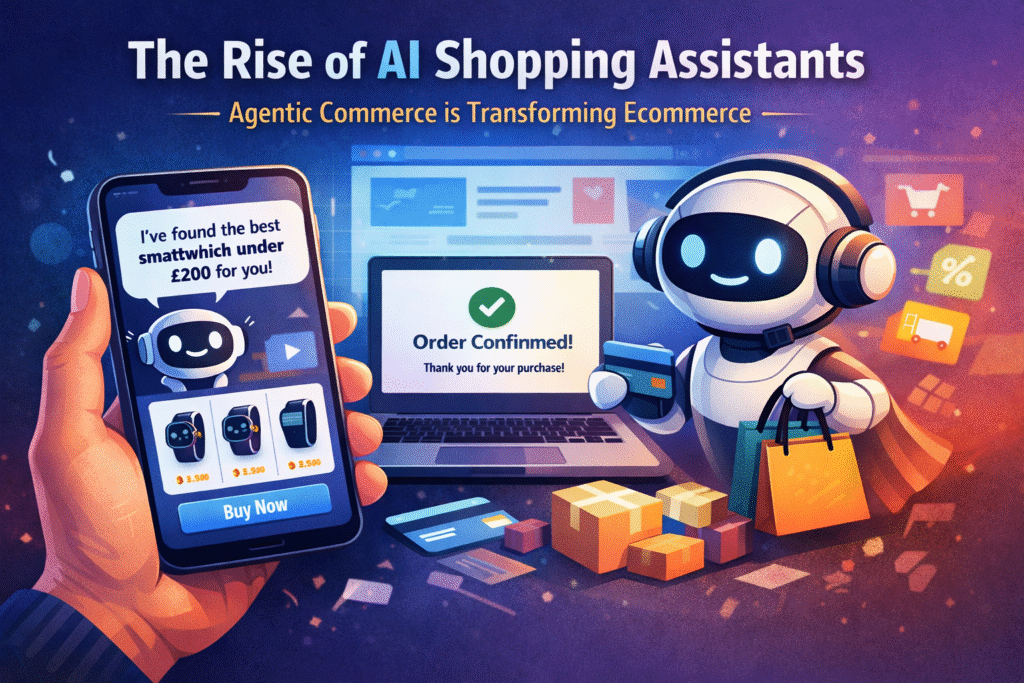
Imagine this: you want to buy a smartwatch for fitness tracking under £200. Instead of visiting multiple websites, filtering options, and reading reviews, you just tell an AI assistant your requirements. Within seconds, it suggests the best options, explains why they’re suitable, and even helps you check out.
This level of automation turns shopping into a conversation rather than a process.
At its core, agentic commerce is about removing friction. It simplifies discovery, decision-making, and purchasing into one seamless experience.
Why This Shift Matters
Ecommerce has already gone through several major transformations—from desktop to mobile, and from offline to online. Agentic commerce is the next big leap.
Here’s why it’s such a game-changer:
1. Shopping Becomes Effortless
Traditional ecommerce requires effort. You need to:
- Search for products
- Compare multiple options
- Evaluate reviews
- Decide what’s best
With AI agents, all of this happens automatically. The user only needs to describe their needs, and the AI delivers curated results.
This saves time and improves decision quality.
2. Discovery Is No Longer the Same
In the past, visibility meant ranking on the first page of search results. Now, AI assistants typically recommend only a handful of products—often just 3 to 5.
This creates a “winner-takes-most” environment.
If your product is recommended, you gain massive visibility. If not, you may become invisible—no matter how good your product is.
3. Trust Becomes More Important Than Ever
AI doesn’t just pick products randomly. It evaluates:
- Product data
- Customer reviews
- Brand reputation
- Consistency across platforms
This means trust signals play a bigger role than ever before. Brands that appear credible, consistent, and well-reviewed will dominate AI recommendations.
How Agentic Commerce Is Changing SEO
Many people think AI will replace SEO—but that’s not true. Instead, SEO is evolving.
To succeed in this new environment, your ecommerce website must be AI-friendly.
Let’s look at the key areas you need to focus on:
1. Structured Data Is Essential
AI systems rely heavily on structured, machine-readable information. This includes:
- Product name
- Price
- Availability
- Specifications
Without proper structure, AI may struggle to understand your product.
Adding schema markup to your product pages is no longer optional—it’s essential.
2. High-Quality Product Information
Your product descriptions should be:
- Clear and detailed
- Accurate and up to date
- Easy to understand
Include specifics like:
- Materials
- Dimensions
- Compatibility
- Use cases
The more detailed your information, the easier it is for AI to evaluate and recommend your product.
3. Reviews Carry More Weight
Customer reviews are one of the strongest signals AI uses.
Products with:
- Positive ratings
- Detailed feedback
- Consistent sentiment
are far more likely to be recommended.
Encouraging customers to leave reviews should be a top priority.
4. Consistency Across Platforms
AI verifies information from multiple sources.
If your product details differ between:
- Your website
- Marketplaces
- Review platforms
it creates confusion—and reduces trust.
Consistency builds confidence, and confidence increases your chances of being recommended.
5. Strong Brand Signals
AI systems treat brands as entities. The stronger your brand presence, the better your chances.
You can strengthen your brand by:
- Being active on social media
- Getting featured in reputable publications
- Listing your business in directories
- Maintaining a consistent online identity
The goal is to make your brand recognisable and trustworthy.
What Businesses Should Do Right Now
Agentic commerce is still in its early stages, which means there’s a huge opportunity for early adopters.
Here’s how you can prepare:
Optimise Your Product Pages
Start by auditing your product pages:
- Add structured data
- Improve descriptions
- Include detailed specifications
- Use high-quality images
Think of your product pages as something both humans and AI need to understand.
Build a Review Strategy
Don’t just wait for reviews—actively collect them.
You can:
- Send follow-up emails after purchase
- Offer incentives for feedback
- Simplify the review process
More reviews = stronger AI trust signals.
Create Comparison Content
AI agents often rely on comparison data.
Create content like:
- “Best products in your category”
- “Product A vs Product B”
- “Top alternatives”
This helps AI understand where your product fits in the market.
Maintain Data Accuracy Everywhere
Ensure your product information is identical across:
- Your website
- Amazon or other marketplaces
- Review sites
- Price comparison platforms
Even small inconsistencies can hurt your credibility.
Explore AI Commerce Integrations
Many platforms are now offering direct checkout integrations with AI assistants.
Joining these programmes can:
- Reduce friction in the buying process
- Increase conversions
- Give you priority visibility
Even if you’re not ready to integrate fully, it’s worth keeping an eye on these opportunities.
Challenges to Be Aware Of
While agentic commerce offers many benefits, it also brings challenges.
Reduced Brand Control
When AI recommends products, it controls the conversation—not you.
This means:
- Less direct interaction with customers
- Less influence over decision-making
You need to rely on strong data and reputation rather than persuasive marketing.
Increased Competition
Since AI shows only a few options, competition becomes intense.
Every brand is fighting for limited visibility.
Dependence on AI Platforms
As more sales happen within AI ecosystems, businesses may become dependent on these platforms.
It’s important to maintain your own channels alongside AI integrations.
The Future of Ecommerce
Agentic commerce is not a temporary trend—it’s the future.
In the coming years, we can expect:
- Fully autonomous shopping experiences
- AI handling repeat purchases automatically
- Personalised recommendations becoming hyper-accurate
- Reduced need for traditional browsing
Shopping will become faster, smarter, and more intuitive.
Final Thoughts
Agentic commerce is redefining how people discover and buy products online. It removes friction, simplifies decisions, and puts AI at the centre of the shopping journey.
For businesses, this shift presents both a challenge and an opportunity.
Those who adapt early—by improving product data, building trust signals, and embracing AI-friendly strategies—will gain a significant advantage.
Those who ignore it risk becoming invisible in an AI-driven marketplace.
The key takeaway?
Don’t wait for the future—start preparing for it today.