
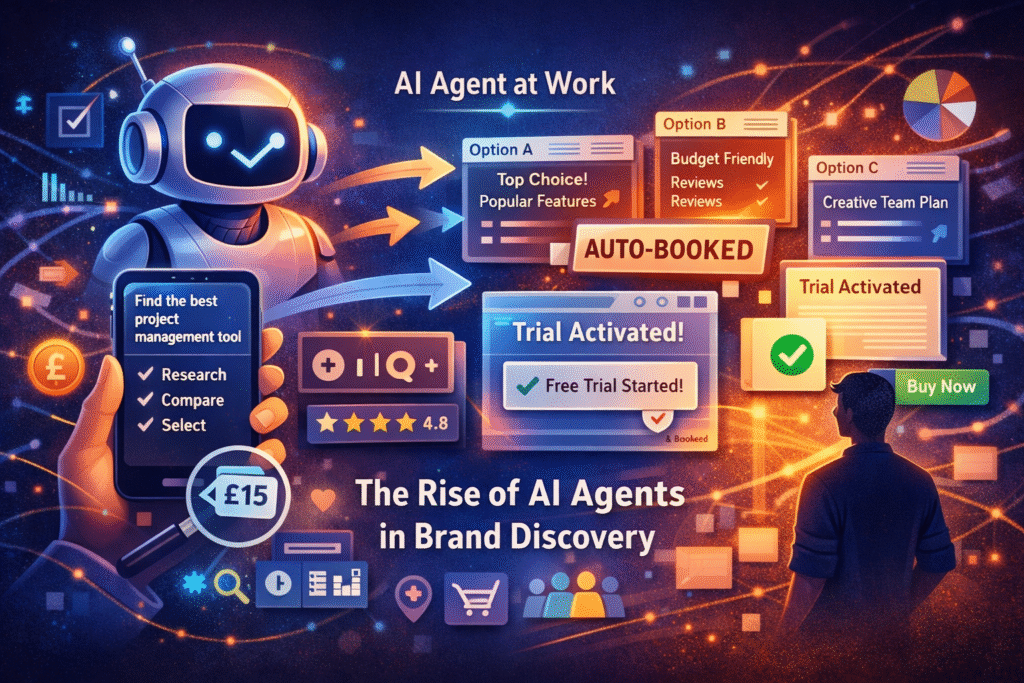
Not long ago, choosing a product or service meant hours of scrolling, comparing, reading reviews, and second-guessing decisions. Today, that process is quietly disappearing. Instead of doing the heavy lifting ourselves, we increasingly rely on AI tools to do it for us. What once felt like a convenience is now becoming a default behaviour — and it’s reshaping how brands get discovered, evaluated, and chosen.
Welcome to a new digital reality where AI doesn’t just assist decisions — it actively makes them.
From Searching to Delegating
Think about your own habits for a moment. When you need a recommendation — whether it’s software, a restaurant, or even a gift — you’re likely turning to an AI assistant. You ask a question, get a curated answer, skim it quickly, and make a decision.
But here’s the shift: you’re no longer the researcher.
You’re the approver.
This subtle behavioural change is at the heart of what many are now calling the delegate economy. Instead of exploring dozens of options yourself, you trust an AI system to shortlist the best ones based on your needs. Over time, as these tools prove reliable, your involvement shrinks further.
Eventually, the AI doesn’t just suggest — it acts.
It signs you up. It books the service. It completes the purchase.
And you? You simply nod in agreement.
A New Layer of the Internet
This transformation is powered by what can be described as an “agent-driven web” — a version of the internet designed not just for humans to browse, but for AI systems to navigate and interact with directly.
Traditionally, websites were built to attract human attention: compelling headlines, engaging visuals, persuasive copy. But AI agents don’t care about aesthetics. They care about clarity, structure, and actionability.
They need to understand:
- What your product does
- Who it’s for
- How much it costs
- Whether it’s credible
- And how to take the next step
If your website doesn’t communicate these things clearly — not just visually, but structurally — it becomes harder for AI to recommend you.
In this new ecosystem, the “best” brand isn’t always the most creative or even the most popular. It’s often the one that is easiest for AI to interpret and trust.
The Shrinking Customer Journey
One of the most profound impacts of AI agents is how they compress the traditional marketing funnel.
In the past, customers moved through distinct stages:
- Awareness
- Consideration
- Decision
Each stage required time, content, and repeated exposure. Brands invested heavily in building familiarity and trust before a purchase ever happened.
Now, those stages are collapsing into a single moment.
By the time a user sees your brand, the AI has already:
- Compared alternatives
- Analysed reviews
- Evaluated pricing
- Assessed features
The decision is largely made before the customer even arrives.
This creates a new kind of interaction — one that feels less like “consideration” and more like validation. The user isn’t exploring options; they’re confirming the AI’s recommendation.
And here’s the challenge: if your brand doesn’t make that shortlist, you’re effectively invisible.
Why Trust Matters More Than Ever
In a world where AI agents act on behalf of users, trust becomes the ultimate currency.
But this isn’t just about brand reputation in the traditional sense. It’s about machine trust — whether an AI system can confidently recommend you based on available data.
AI agents look for signals such as:
- Consistent messaging across your site
- Transparent pricing
- Detailed product information
- Verified reviews
- Third-party validation
If these signals are missing or unclear, the agent hesitates. And hesitation often leads to exclusion.
On the other hand, brands that provide structured, verifiable, and consistent information gain a significant advantage. They reduce friction for the AI, making it easier to recommend — and ultimately choose — them.
Clarity Beats Creativity
For years, marketing has celebrated creativity: clever slogans, bold campaigns, and emotional storytelling. While these still have value, they’re no longer enough on their own.
AI agents don’t interpret nuance the way humans do. They prioritise clarity over cleverness.
That means your messaging needs to answer key questions directly:
- Who is this for?
- What problem does it solve?
- Why is it better than alternatives?
Vague or overly broad positioning becomes a liability. If your brand tries to appeal to everyone, it may end up connecting with no one — at least in the eyes of an AI.
Specificity, on the other hand, becomes a strength.
The Power of Being Specific
One of the most important shifts in this new landscape is the need to clearly define your audience.
AI agents don’t perform generic searches. They match solutions to highly specific user needs — often including budget, industry, preferences, and constraints.
For example, instead of searching for “project management software,” an AI might look for:
- Tools for small creative teams
- Budget-friendly options under a certain price
- Features like time tracking or client dashboards
If your brand clearly communicates these details, you’re far more likely to be included in the results.
This applies across industries — from software to e-commerce. Brands that articulate their ideal customer and tailor their content accordingly are easier for AI to match.
Your Website Is Now a System, Not Just a Showcase
In the past, a website’s primary role was to persuade human visitors. Today, it must also function as a system that AI can interact with.
This means thinking beyond design and focusing on structure.
Key elements include:
- Well-organised product data
- Clear navigation and categorisation
- Structured information (such as schema markup)
- Accessible and consistent content
The easier it is for an AI to navigate and extract information from your site, the more likely it is to recommend your brand.
In many ways, your website becomes less of a brochure and more of an interface — one that serves both humans and machines.
The Role of Reviews and Real-World Data
Another critical factor in AI-driven decision-making is the quality of your data — especially user-generated content.
Reviews are no longer just social proof for human buyers. They’re a rich source of information for AI systems trying to assess fit.
Detailed reviews that include context — such as use cases, preferences, or specific outcomes — are particularly valuable. They help AI understand not just whether a product is good, but who it’s good for.
Brands that encourage detailed, structured feedback from customers gain an edge. They provide the kind of nuanced data that AI agents rely on to make accurate recommendations.
A New Kind of Visibility
One of the biggest challenges in this evolving landscape is measurement.
Traditionally, brands tracked visibility through metrics like:
- Website traffic
- Search rankings
- Click-through rates
But what happens when decisions are made inside AI systems — often without the user ever visiting your site?
You might be recommended, evaluated, and even selected without seeing a single click.
This creates a visibility gap. Brands need new ways to understand how they’re being represented and perceived by AI systems.
While tools and metrics are still catching up, one thing is clear: visibility is no longer just about being seen by people. It’s about being recognised and trusted by machines.
Adapting to the Future
So, what does all this mean for brands?
It doesn’t require a complete reinvention — but it does demand a shift in priorities.
To stay competitive in an AI-driven landscape, brands should focus on:
- Clarity: Make your value proposition obvious and specific
- Structure: Organise your content so it’s easy to interpret
- Credibility: Provide verifiable information and third-party validation
- Relevance: Clearly define who your product is for
- Consistency: Ensure your messaging aligns across all channels
These aren’t new principles. In many ways, they reflect good marketing fundamentals. But in the age of AI agents, their importance is amplified.
The Bigger Picture
The rise of AI agents isn’t just a technological shift — it’s a behavioural one.
As users grow more comfortable delegating decisions, the role of brands changes. You’re no longer just competing for attention; you’re competing for selection within an AI’s decision-making process.
And that process is fast, data-driven, and increasingly autonomous.
The brands that succeed will be those that adapt early — not by chasing trends, but by making themselves easier to understand, trust, and choose.
Because in a world where AI does the deciding, the question isn’t just whether customers can find you.
It’s whether the agent thinks you’re worth choosing at all.