
If you want your business to grow in a crowded market, guessing is not a strategy. You need clarity on who you’re competing with, what they’re doing well, where they’re falling short, and how you can position yourself more effectively. That’s exactly where competitive analysis comes in.
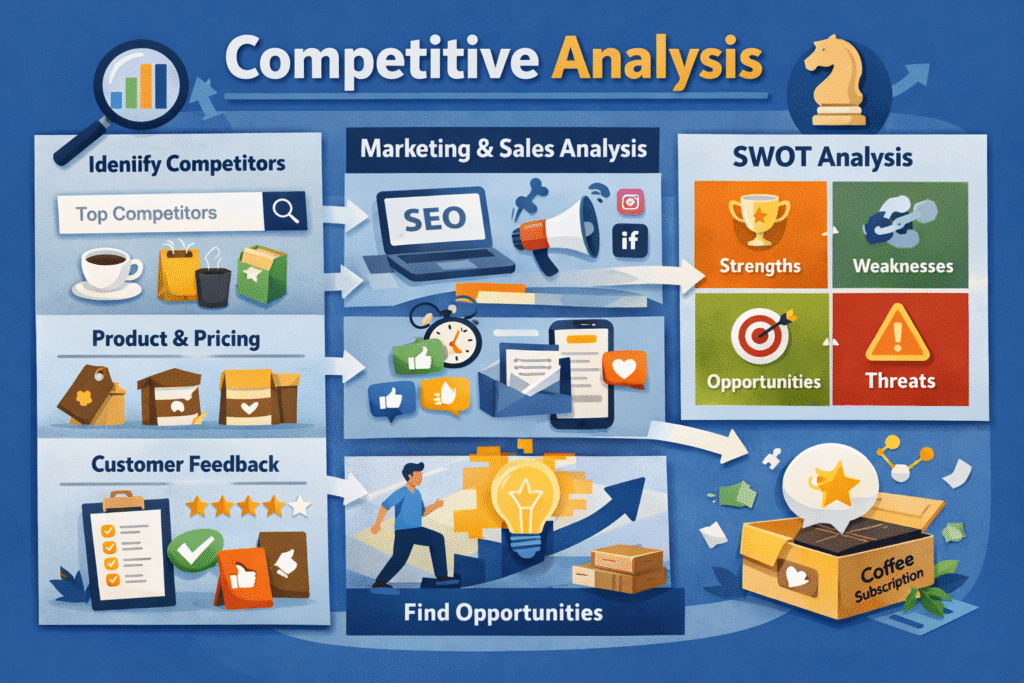
In simple terms, competitive analysis is the structured process of researching your competitors’ products, marketing, sales, and customer experience so you can make smarter decisions for your own business. It’s not about copying others. It’s about learning from the market and identifying opportunities they’ve missed.
Whether you’re launching a new venture or trying to improve results for an existing brand, a well-prepared competitive analysis report can become one of your most valuable strategic tools.
Why Competitive Analysis Matters
Many businesses skip this step because they feel they already “know” their competitors. But assumptions are rarely accurate. A proper analysis helps you:
1. Learn from real-world testing
Your competitors have already invested time, money, and effort into testing offers, messaging, pricing models, and campaigns. By observing what has worked for them (and what hasn’t), you avoid costly trial and error.
2. Identify gaps in the market
Sometimes competitors overlook specific audiences or fail to deliver certain features customers want. These gaps can become powerful growth opportunities for you.
3. Improve your positioning
Understanding how others present themselves allows you to sharpen your own unique value proposition. If everyone claims to be “premium”, perhaps there’s space for a more accessible alternative. If competitors compete on price, maybe service quality is the real differentiator.
Competitive analysis is also referred to as competition analysis or competitive market analysis, but the purpose remains the same: strategic clarity.
Step-by-Step: How to Conduct a Competitive Analysis
Let’s break the process down into manageable steps.
Step 1: Create a Clear Framework
Before diving in, prepare a structured document where you’ll record your findings. A simple template might include:
- Competitor overview
- Products or services
- Pricing
- Marketing channels
- Content strategy
- Sales process
- Customer feedback
- Strengths and weaknesses
- Your positioning insights
Using a consistent format for each competitor ensures fair comparisons and better decision-making.
Step 2: Identify the Right Competitors
Start with direct competitors — businesses offering similar products or services to a similar audience.
You can find them by:
- Searching Google for your core service keywords
- Checking industry directories and review platforms
- Asking your sales team which alternatives prospects mention
- Reviewing where past customers have switched
Initially, focus on three competitors. This keeps your research deep rather than scattered. Later, you can expand to include indirect competitors (those solving the same problem in a different way).
Step 3: Analyse Products or Services
Visit each competitor’s website and study their homepage carefully. Ask yourself:
- What problem do they claim to solve?
- Who are they targeting?
- What makes them different?
Then go deeper:
Core features and benefits – What functionalities do they highlight? Are there unique tools, guarantees, or added extras?
Pricing structure – Are they positioned as premium, mid-range, or budget? Do they offer tiered packages?
User experience – Is their website easy to navigate? Is the buying process smooth?
This stage often reveals opportunities. If every competitor offers monthly plans, perhaps bi-monthly or flexible subscriptions could differentiate you.
Step 4: Review Marketing Channels
Understanding how competitors attract traffic gives you valuable direction.
Look at:
- Organic search visibility
- Paid advertising presence
- Social media platforms
- Referral sources
- Email marketing
Pay attention to content formats too:
- Do they run a blog?
- Are they hosting webinars?
- Do they publish guides or case studies?
- Are they active on Instagram, LinkedIn, or TikTok?
Instead of simply noting where they appear, analyse how well they execute. For example, if a competitor’s blog drives significant traffic despite infrequent publishing, that signals strong SEO foundations — and a potential opportunity for you to outperform with consistent, updated content.
Also consider emerging channels, such as traffic from AI-driven platforms and generative search tools. Early adoption in these areas could provide a long-term advantage.
Step 5: Study the Sales Process
Marketing attracts attention. Sales convert it.
To understand a competitor’s sales strategy, experience it yourself:
- Subscribe to their newsletter
- Request a demo
- Start the checkout process
- Download gated content
Observe:
How they present their offer – Do they use quizzes, consultations, or detailed product comparisons?
Follow-up approach – Are they sending automated email reminders? Offering limited-time discounts?
Closing tactics – Do they use bundles, guarantees, or loyalty rewards?
Retention strategies – Are there loyalty programmes, exclusive content, or renewal incentives?
This hands-on research often reveals psychological triggers and conversion techniques you can ethically adapt.
Step 6: Examine Customer Feedback
Customer reviews are goldmines of insight.
Search for “[competitor name] reviews” and explore:
- Third-party review sites
- Industry blogs
- Reddit and LinkedIn discussions
- Social media comments
Look for recurring themes:
- What do customers consistently praise?
- What frustrations appear repeatedly?
- Are there service issues or delivery complaints?
If multiple customers mention slow customer support, that’s a clear weakness. If users rave about easy onboarding, that’s a strength worth noting.
Patterns matter more than isolated opinions.
Step 7: Identify Strengths and Weaknesses
After collecting data, step back and evaluate:
- Where do competitors excel?
- Where do they struggle?
- Are there underserved audience segments?
- Are there outdated features or missing innovations?
This is where your competitive analysis becomes strategic rather than descriptive.
Step 8: Conduct a SWOT Analysis
Now evaluate your own business in context:
- Strengths – What do you do better?
- Weaknesses – Where do you need improvement?
- Opportunities – What market gaps exist?
- Threats – What risks do competitors pose?
Your differentiators might include:
- A more flexible pricing model
- Faster onboarding
- Better customer service
- A niche audience focus
- Superior educational content
This forms the foundation of your unique value proposition.
Example: Coffee Subscription Business
Imagine you’re launching a coffee subscription service.
After researching competitors, you might discover:
- Most offer monthly deliveries only
- All use quiz-style subscription builders
- Influencer marketing works well on Instagram
- Email discounts are common conversion tactics
- Customers complain about lack of customisation
From this, you could:
- Offer fortnightly delivery options
- Provide more granular taste preferences
- Focus marketing efforts on TikTok if competitors ignore it
- Create fresher blog content to dominate organic search
Instead of copying, you’re strategically positioning your service based on real evidence.
Best Practices for Effective Competitive Analysis
To ensure your analysis is genuinely useful:
Base decisions on data – Avoid assumptions. Use measurable insights wherever possible.
Stay consistent – Analyse each competitor using the same criteria.
Customise your framework – Depending on your industry, you may need to assess technology, partnerships, or brand reputation.
Combine tools with manual research – Data tools provide numbers; manual review provides context and nuance.
Review regularly – Markets evolve. Competitive analysis isn’t a one-time task.
Final Thoughts
Competitive analysis is not about obsessing over rivals. It’s about understanding your environment so you can compete intelligently.
When done properly, it highlights blind spots, sharpens positioning, and uncovers growth opportunities you might otherwise miss. It gives you confidence to make decisions based on evidence rather than instinct.
In today’s competitive digital landscape, businesses that actively monitor and adapt outperform those that operate in isolation. A thoughtful, structured competitive analysis can become the strategic compass guiding your next stage of growth.
If you haven’t conducted one yet, now is the perfect time to start.