
Not long ago, building a website or web application meant one thing: you needed to code. If you didn’t understand HTML, CSS, JavaScript, databases, hosting, and deployment, your idea would likely remain just that — an idea.
Today, that reality is shifting.
A new wave of AI-powered creation tools is quietly transforming how digital products are built. At the centre of this shift is vibe coding — a growing movement where people describe what they want in plain language, and AI turns those ideas into fully functional websites and apps. Instead of wrestling with syntax and frameworks, creators simply explain their vision. The system handles the heavy lifting.
This isn’t just a technical upgrade. It’s a cultural shift in how software is created.
What Exactly Is Vibe Coding?
Vibe coding is the process of building digital products by describing them conversationally rather than programming them manually. You don’t write lines of code — you explain what you want:
- “Create a booking system for my dog grooming business.”
- “Build a portfolio website with a dark theme and animated transitions.”
- “I need a budgeting app for students with monthly reports.”
The AI interprets your request, generates the structure, designs the layout, configures the logic, and prepares it for launch. If something needs changing, you simply tell it — much like editing a document with a colleague.
The result? Faster creation, fewer technical barriers, and a dramatically shorter path from idea to launch.
Who Is Actually Using These Tools?
One of the most surprising aspects of vibe coding platforms is the diversity of users.
You might assume that only tech enthusiasts are experimenting with AI-led development. In reality, the user base spans a remarkably wide spectrum:
1. Students and First-Time Builders
Young creators are using AI platforms to build:
- School project websites
- Online CVs and portfolios
- Small community initiatives
- Early-stage startup ideas
For many, this is their first exposure to digital product creation — and they’re skipping the intimidating learning curve entirely.
2. Entrepreneurs and Side-Hustlers
Small business owners are launching:
- E-commerce shops
- Booking systems
- Membership platforms
- Lead generation landing pages
Instead of hiring agencies or learning development from scratch, they can prototype and launch within days.
3. Experienced Developers
Interestingly, even seasoned coders are using AI builders — not as replacements, but as accelerators. They use them for:
- Rapid prototyping
- Testing new product ideas
- Creating MVPs for clients
- Speeding up repetitive build processes
It’s not about replacing expertise. It’s about amplifying productivity.
What Are People Actually Building?
When you remove the coding barrier, creativity tends to explode.
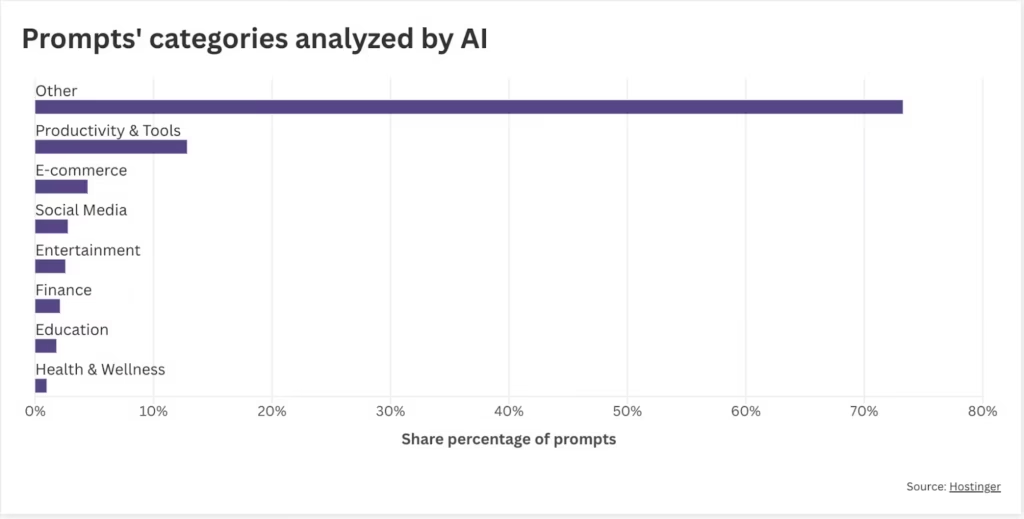
Users aren’t just creating simple brochure websites. They’re building:
Productivity Tools
Task trackers, habit builders, lightweight CRM systems, team dashboards, time planners — practical tools designed to solve real everyday problems.
Online Shops
Niche product stores, digital downloads, print-on-demand shops, and subscription-based services.
Learning Platforms
Mini course portals, revision tools for students, quiz generators, coaching dashboards, and private learning communities.
Financial Trackers
Budgeting apps, invoice generators, savings planners, and basic investment tracking systems.
Community & Social Platforms
Event coordination apps, local networking hubs, interest-based micro-communities.
And then there’s the wildcard category — the ideas that don’t fit neatly into a box. AI builders are increasingly used for experimental projects, personal tools, passion projects, and hybrid concepts that blend multiple functions.
That “other” category is often where the most interesting innovation happens.
Why Is This Taking Off So Quickly?
There are a few key reasons vibe coding is growing at such speed.
1. Speed
Traditional development can take weeks or months. With AI-assisted building, a functional version can appear in minutes. That dramatically changes the psychology of creation. When feedback loops are short, people experiment more.
2. Accessibility
You no longer need to:
- Understand hosting infrastructure
- Configure databases manually
- Connect APIs by hand
- Debug deployment errors
For non-technical users, this removes layers of friction that previously stopped ideas from ever getting built.
3. Iteration Without Fear
Because changes can be made conversationally, users aren’t afraid to test improvements. You can say:
“Add a testimonial section.”
“Make the homepage cleaner.”
“Include a payment option.”
Instead of starting from scratch, you refine continuously.
From Idea to Income: The Monetisation Shift
Another major factor driving adoption is built-in monetisation.
Modern AI website builders now allow creators to integrate payment systems, memberships, and subscriptions without complex setup. That means:
- Artists can sell digital products.
- Coaches can offer paid programmes.
- Freelancers can charge for bookings.
- Developers can validate SaaS ideas quickly.
The ability to test whether people will actually pay — without investing thousands upfront — changes the risk equation entirely.
For many users, vibe coding isn’t just creative — it’s commercial.
Built-In Back-End Power
Previously, setting up a database, authentication system, or file storage solution required separate services and technical integration. Now, backend systems can often be connected in just a few steps.
Data storage, login systems, content management — all handled behind the scenes.
This matters because it moves AI building from “nice-looking websites” to fully functional web applications.
Automatic Fixes and Real-Time Improvements
One of the biggest frustrations in traditional coding is debugging.
AI-led platforms increasingly include automatic error detection and repair systems. When something breaks, the system can often identify and fix common issues without user intervention.
That means fewer interruptions and more focus on improving the product rather than troubleshooting it.
Global Adoption: Not Just a Tech Trend
The adoption of vibe coding isn’t limited to Silicon Valley startups. It’s global.
Creators across Europe, Asia, North America, and Latin America are experimenting with AI-led product development. Support for dozens of languages means people can build in their native tongue.
This multilingual capability removes yet another barrier. You don’t have to think in “technical English” anymore — you can think in your own language.
That inclusivity plays a major role in the democratisation of technology.
Is This the End of Traditional Coding?
Not at all.
Professional developers still play a vital role — especially in complex systems, enterprise solutions, and highly customised platforms.
However, the entry-level barrier has shifted dramatically.
Instead of needing:
- Months of learning
- Expensive development contracts
- Specialist technical support
Many users can now build version one themselves.
For simple products and MVPs, that’s revolutionary.
The Psychology of Creation Has Changed
Perhaps the most important impact isn’t technical — it’s psychological.
When the cost of experimentation drops to almost zero, people try more ideas.
In the past:
- You thought carefully before investing in development.
- You hesitated before changing structure.
- You avoided bold ideas due to risk.
Now:
- You test.
- You tweak.
- You relaunch.
Creativity becomes fluid rather than constrained.
The Next Step: Visual Editing
While conversational AI drives large structural changes, visual editing tools are evolving alongside it. Soon, users will increasingly be able to click directly on text, images, or sections and make instant edits without returning to chat.
That blend — conversational AI for major builds and visual tools for quick refinements — represents a powerful hybrid model.
It gives beginners simplicity while offering more advanced users greater precision.
A Tool for Every Level
What makes vibe coding platforms compelling is flexibility:
- Beginners can rely fully on AI guidance.
- Intermediate users can customise layouts and features.
- Advanced users can download and modify code directly if needed.
This layered approach ensures the platform doesn’t become restrictive as users grow more confident.
What This Means for the Future of Entrepreneurship
We are entering an era where software creation is no longer restricted to engineers.
The next wave of entrepreneurs may not describe themselves as “technical founders.” They’ll be:
- Creators
- Designers
- Coaches
- Freelancers
- Students
- Hobbyists
People who once felt locked out of product development now have a doorway.
The ability to launch, test, monetise, and iterate independently could spark a surge of micro-startups and niche solutions built by individuals rather than teams.
Final Thoughts: This Is Just the Beginning
AI-powered website and app builders are not a passing trend. They represent a structural shift in how digital products come to life.
Vibe coding isn’t about removing developers. It’s about removing unnecessary barriers.
It’s about turning:
- “I wish someone would build this”
into - “I’ll build it myself.”
As these tools continue to evolve — with stronger backend integrations, smarter AI corrections, and improved visual controls — the gap between idea and execution will shrink even further.
For anyone sitting on an idea but waiting for the “right time” or the “right technical partner,” the landscape has changed.
You no longer need to code.
You simply need to describe your vision — and let the technology do the rest.