
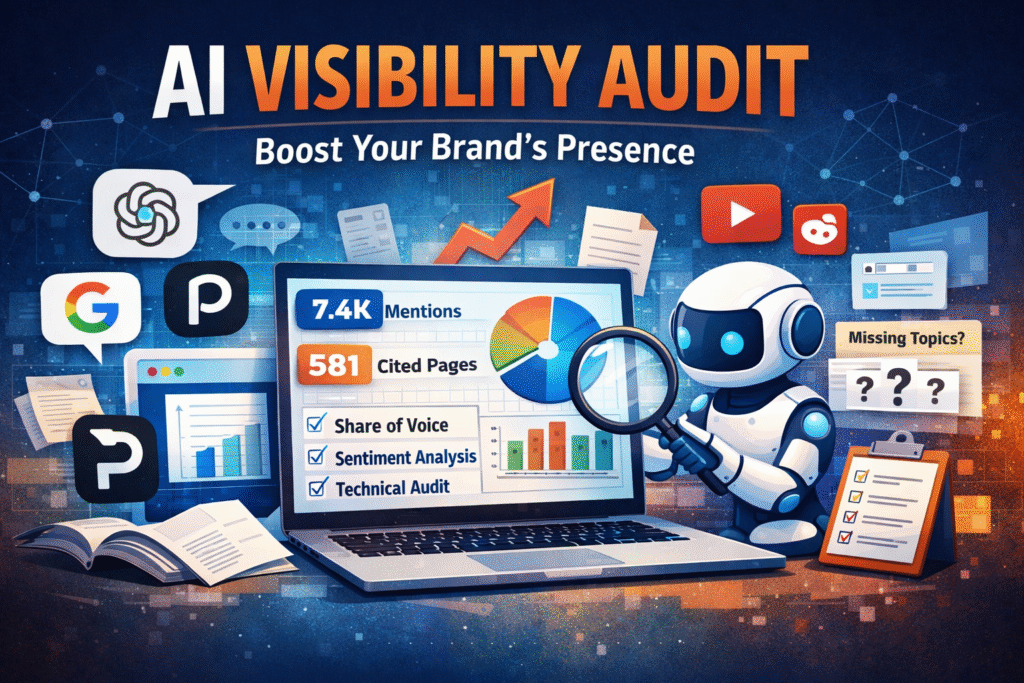
Artificial intelligence is quietly reshaping the way people discover brands. Instead of clicking through ten blue links, users now ask tools like ChatGPT, Google AI Overviews, or Perplexity direct questions — and receive instant, summarised recommendations.
But here’s the real question:
Is your brand being recommended in AI-generated answers?
If not, you’re missing a growing stream of visibility, authority, and trust.
In this guide, we’ll walk through how to conduct a practical, real-world AI visibility audit for your business. This isn’t just about tracking mentions. It’s about understanding how AI systems interpret your brand, where you’re being cited, and what you can improve to increase your presence in AI-powered search.
You’ll also see clearly marked keyword placements so you can insert your own URLs where needed.
Why an AI Visibility Audit Matters in 2026
Search behaviour is evolving.
When someone types:
- “Best running shoes for flat feet”
- “Most sustainable clothing brands”
- “Top marketing tools for small businesses”
AI tools don’t just list websites — they generate curated answers.
That means:
- You may not get the click.
- You may not even get shown.
- Or worse — your competitors may be recommended instead.
An AI visibility audit helps you answer three core questions:
- Is my brand being mentioned in AI-generated responses?
- Which of my pages are being cited?
- Where are competitors outperforming me in AI search?
Step 1: Measure Your Current AI Presence
Before improving anything, you need a benchmark.
Start by analysing:
- Brand mentions across AI platforms
- Share of voice versus competitors
- Cited URLs
- Topic coverage gaps
If you are using <span style=”background-color:#fff3cd;”><strong>AI visibility audit services</strong></span>, this is usually where reporting begins.
What to Look For
✔ Number of times your brand appears
✔ Prompts where competitors are mentioned but you’re not
✔ Pages that AI systems pull information from
✔ Tone and sentiment around your brand
This baseline gives you something measurable. Without it, optimisation becomes guesswork.
Step 2: Identify Citation-Worthy Content
AI systems favour:
- Educational guides
- Comparison articles
- How-to content
- Structured FAQs
- Clear summaries
They rarely prioritise thin product pages alone.
If you offer <span style=”background-color:#fff3cd;”><strong>AI search optimisation services</strong></span>, this is a major opportunity. Many brands rank in Google but don’t get cited in AI summaries because their content isn’t structured for machine interpretation.
Audit Your Pages:
Ask:
- Which URLs are being cited?
- Are they informational or transactional?
- Do they contain structured headings and concise summaries?
- Are competitors’ pages being cited instead?
If your homepage is cited but deeper content isn’t, you may need clearer internal linking and topical depth.
Step 3: Find Topic Gaps Where Competitors Appear
This is where the real gold lies.
AI systems answer specific prompts. For example:
- “Best eco-friendly trainers”
- “Affordable CRM software for startups”
- “How to reduce electricity bills in winter”
If competitors are mentioned for these queries and you’re not, that’s a topical gap.
This is where a proper <span style=”background-color:#fff3cd;”><strong>AI brand visibility strategy</strong></span> becomes critical.
How to Identify Gaps
- Review high-volume category prompts.
- Note brands consistently mentioned.
- Check whether your content addresses the same questions clearly.
If AI doesn’t “see” you as an authority in that topic, it won’t recommend you.
Step 4: Analyse Brand Sentiment in AI Responses
Unlike traditional rankings, AI doesn’t simply “rank” websites. It describes brands.
For example:
“Brand A is budget-friendly but lacks durability.”
“Brand B is premium but environmentally conscious.”
That framing influences perception massively.
If you offer <span style=”background-color:#fff3cd;”><strong>AI reputation management services</strong></span>, this is where you focus.
Look For:
- Positive vs negative sentiment
- Repeated brand descriptors
- Pros and cons mentioned
- Comparison positioning
AI narrative matters. If competitors are framed as “industry leaders” while you’re described as “affordable”, the positioning gap becomes obvious.
Step 5: Evaluate Off-Site Influence
AI models frequently cite:
- Reddit discussions
- YouTube reviews
- Medium articles
- LinkedIn posts
- Quora threads
If your brand presence is weak on third-party platforms, AI visibility suffers.
This is especially important if you provide <span style=”background-color:#fff3cd;”><strong>AI citation building services</strong></span>.
Questions to Ask:
- Are review platforms influencing AI answers?
- Are YouTube creators shaping the narrative?
- Are competitor Reddit threads being cited?
If yes, you need off-site visibility, not just on-site optimisation.
Step 6: Audit Technical Readiness for AI Crawling
Technical structure still matters.
AI systems interpret:
- Internal linking clarity
- Descriptive anchor text
- Page structure (H1, H2, H3 hierarchy)
- Concise summaries
- Structured FAQs
If you specialise in <span style=”background-color:#fff3cd;”><strong>technical AI SEO optimisation</strong></span>, these are key elements to review.
Common Technical Barriers:
- Orphan pages
- Poorly described links
- Thin content
- Lack of semantic structure
- Missing contextual connections
AI tools don’t block content randomly — they favour clarity.
The clearer your architecture, the more reusable your content becomes.
Step 7: Turn Insights Into an Action Plan
An audit without action is wasted effort.
Here’s a practical roadmap:
Immediate (Week 1)
✔ Fix internal linking issues
✔ Improve structured headings
✔ Add concise summary paragraphs
Short-Term (Weeks 2–4)
✔ Optimise high-ranking pages for AI citation
✔ Expand FAQs
✔ Strengthen competitor-comparison content
Mid-Term (Months 2–3)
✔ Build missing topical clusters
✔ Improve off-site brand mentions
✔ Develop authority-based educational content
If you provide <span style=”background-color:#fff3cd;”><strong>AI content optimisation services</strong></span>, this stage is where ongoing growth happens.
How AI Visibility Differs from Traditional SEO
Traditional SEO focuses on:
- Rankings
- Click-through rate
- Backlinks
AI visibility focuses on:
- Mentions
- Citations
- Narrative framing
- Topical authority
- Contextual clarity
You can rank #1 in Google and still not appear in AI-generated answers.
That’s why brands are increasingly investing in <span style=”background-color:#fff3cd;”><strong>AI search visibility consulting</strong></span> rather than just standard SEO.
Delivering an AI Visibility Report to Clients
If you’re creating reports for clients, keep them:
✔ Clear
✔ Visual
✔ Benchmark-driven
✔ Action-focused
You can deliver via:
- Screenshot-based PDF
- Branded report template
- Video walkthrough
- Executive summary document
Focus on measurable metrics, not vague recommendations.
Final Thoughts: AI Visibility Is the Next Competitive Edge
AI-generated search results are not replacing traditional SEO — they’re redefining it.
Brands that adapt early will:
- Increase authority
- Control narrative framing
- Strengthen digital reputation
- Capture recommendation-based traffic
Those that ignore AI visibility may slowly disappear from conversational search.
An AI visibility audit gives you clarity.
It shows:
- Where you stand
- Where you’re missing
- Where competitors dominate
- What actions will improve positioning
And most importantly — it transforms AI from a black box into something measurable and optimisable.