
Search is changing faster than many businesses expected. People are no longer relying only on traditional search engines to find products, services, brands and answers. They are increasingly turning to AI-powered platforms to compare options, research problems, understand complicated topics and decide what to buy.
This creates a new opportunity for businesses: becoming visible inside AI-generated answers.
However, getting mentioned by an AI system is only the beginning. A brand may appear in dozens of AI responses without generating a single measurable click. At the same time, a customer might discover a company through an AI recommendation, remember the brand, search for it later and eventually become a customer through another channel.
That makes AI search visibility very different from traditional organic search measurement.
Businesses therefore need to look beyond simple mentions and rankings. The real question is not just whether an AI platform talks about your brand, but whether that visibility contributes to awareness, qualified enquiries, sales and long-term revenue.
Why AI Visibility Matters More Than a Simple Mention
A mention in an AI-generated answer can influence a potential customer at a very important stage of their buying journey.
Consider someone looking for a new accounting software solution. Instead of searching for ten different websites, they might ask an AI platform to recommend the best options for a small business. If your software is included in that answer, you have already entered the customer’s consideration set.
The customer may not click your website immediately.
They might ask another question, compare your company with competitors, check reviews, search your brand name on Google or return to your website several days later.
Traditional analytics can struggle to connect those actions back to the original AI interaction.
This is why AI visibility should be treated as more than another traffic source. It can act as an influence layer that affects how people discover, evaluate and remember a business.
The commercial value may appear later through another channel.
From AI Visibility to Revenue
The journey from AI visibility to revenue is rarely completely straightforward.
A useful way to understand it is to break the customer journey into several stages:
AI visibility → awareness → consideration → website visit → enquiry → conversion → revenue
Not every customer will follow this exact path. Some may click directly from an AI platform, while others may never click an AI-generated link at all.
For example, a customer could:
- Discover your company through ChatGPT
- Search your brand on Google two days later
- Read several pages on your website
- Return through a direct visit
- Submit an enquiry
- Speak to your sales team
- Become a customer
If your reporting only credits the final direct visit, the original AI discovery disappears from the story.
This is one of the biggest reasons why businesses need a broader AI attribution strategy.
What Should Businesses Measure?
A strong measurement system should not depend on one metric.
Instead, businesses should monitor a combination of visibility, engagement, conversion and financial indicators.
1. AI Visibility
The first layer measures how frequently your business appears in AI-generated responses.
Useful measurements include:
- Brand mentions
- Citation frequency
- AI share of voice
- Prompt visibility
- Competitor presence
- Sentiment
- Product or service recommendations
- The sources AI platforms use when mentioning your business
These metrics help answer an important question:
Are AI systems increasingly recognising your business as a relevant source or recommendation?
A growing presence is encouraging, but it should not automatically be treated as revenue.
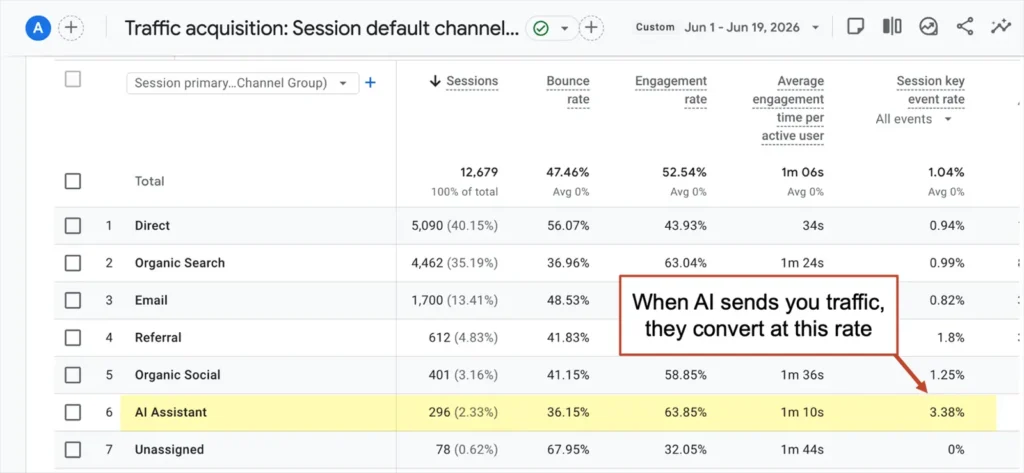
2. AI Referral Traffic
The next step is identifying visitors who arrive from AI platforms.
Traffic from platforms such as ChatGPT, Gemini, Perplexity and other AI services can provide useful information about actual user behaviour.
Look at:
- Number of AI-referred sessions
- Engagement rate
- Pages viewed
- Key events
- Enquiries
- Purchases
- Sign-ups
- Revenue per visitor
The volume may initially be smaller than traditional organic traffic. That does not necessarily mean it has less value.
In many cases, an AI-referred visitor has already completed part of the research process before reaching your website. They may arrive with a clearer understanding of what they need and what your business offers.
This makes AI referral traffic an important metric, but quality should always be considered alongside quantity.
The Importance of Branded Search
One of the most overlooked signals of AI influence is branded search.
Someone might see your company mentioned in an AI response but never click the recommendation. Instead, they may later search for your brand directly.
From an analytics perspective, that visit may look like a Google organic search.
Without additional analysis, you could incorrectly conclude that traditional SEO generated the entire interaction.
This is why businesses should monitor branded search growth alongside AI visibility.
If your AI presence increases and branded searches begin rising over the same period, that can provide useful supporting evidence of growing awareness.
It is not definitive proof of causation, but it is a valuable signal when combined with other data.
Connect AI Data With Your CRM
Website analytics can only tell part of the story.
For businesses that generate leads, the CRM is often where the most valuable information sits.
A lead may discover your business through AI but eventually contact you through:
- A contact form
- Telephone
- A booking system
- A sales representative
- A referral
- A branded search
Your CRM should therefore record AI-related discovery wherever possible.
Useful fields include:
AI discovery source, AI platform, self-reported attribution, lead quality, pipeline value and closed revenue.
Adding a simple question to your enquiry form can also be surprisingly effective.
For example:
“Where did you first hear about us?”
The answers could include:
- Social media
- Recommendation
- ChatGPT or another AI tool
- Online directory
- Existing customer
- Other
You can then compare the performance of AI-influenced leads with leads from other channels.
Ask Customers Directly
Not every AI interaction leaves a digital trail.
This is particularly common with B2B companies and higher-value services.
A prospect might tell a salesperson:
“I asked ChatGPT about companies that could help with this.”
That information may never appear in Google Analytics.
Sales teams should therefore become part of your AI attribution process.
A simple question during a sales conversation can reveal valuable information:
“How did you first come across our company?”
If the customer gives a broad answer such as “online”, the salesperson can gently ask:
“Was that through Google, social media, an AI tool or somewhere else?”
These conversations can reveal patterns that automated analytics cannot.
Over time, those patterns can help businesses understand whether AI is genuinely influencing purchasing decisions.
Measuring AI-Influenced Leads
Once AI discovery data is being collected, businesses can start separating different types of leads.
A practical approach is to use four categories.
Direct AI Leads
These are customers who arrive through a trackable AI referral and subsequently convert.
This is the easiest form of AI attribution to demonstrate because there is a measurable connection between the source and the conversion.
AI-Assisted Leads
These are customers who interacted with AI but converted through another identifiable channel.
For example:
AI recommendation → Google search → website → enquiry.
The AI interaction influenced the journey, even though it was not the final source.
Self-Reported AI Leads
These are customers who tell you that they discovered your business through an AI platform.
There may be no technical tracking evidence, but the customer has provided first-party information.
Modelled AI Influence
This is an estimated contribution based on available data.
For example, if AI visibility increases significantly, branded demand rises, AI traffic grows and AI-referred visitors convert at a strong rate, a business may create a conservative model of the additional revenue influenced by AI.
This figure should always be clearly labelled as estimated rather than presented as directly measured revenue.
Calculating the Commercial Value of AI Traffic
Once enough data has been collected, businesses can begin estimating financial impact.
For ecommerce websites, a straightforward model is:
AI-attributed visitors × conversion rate × average order value = estimated revenue
For example, suppose an ecommerce website receives 2,000 visitors from AI platforms.
If the conversion rate is 2.5% and the average order value is £75:
2,000 × 0.025 × £75 = £3,750
That gives an estimated £3,750 in revenue.
However, revenue is not the same as profit.
If the business operates with a 55% gross margin, the estimated gross profit would be:
£3,750 × 55% = £2,062.50
This is a more useful number when calculating AI visibility ROI.
Measuring AI Impact for B2B Companies
B2B businesses need a slightly different approach because a website visitor rarely becomes a customer immediately.
A typical B2B journey may involve:
AI discovery → website visit → lead → qualified lead → sales meeting → proposal → closed deal.
A simple estimation formula can therefore be:
AI visits × lead rate × qualification rate × close rate × average contract value
Imagine a business receives 1,500 AI-related visits.
If:
- Lead rate = 5%
- Qualified-lead rate = 40%
- Close rate = 20%
- Average contract value = £8,000
The calculation would be:
1,500 × 5% = 75 leads
75 × 40% = 30 qualified leads
30 × 20% = 6 customers
6 × £8,000 = £48,000 estimated revenue
The calculation is only as reliable as the underlying data. That is why businesses should use their own CRM performance wherever possible rather than relying on generic industry averages.
Why Revenue Attribution Can Be Difficult
Attribution has always been complicated, but AI makes the problem more visible.
Traditional analytics were largely designed around trackable interactions such as clicks, sessions and conversions.
AI changes the discovery process.
A customer can ask an AI platform a question, receive a recommendation and leave without visiting the recommended website.
There may be no referral session.
There may be no cookie.
There may be no immediate conversion.
But the recommendation could still influence the eventual purchase.
This is often described as a zero-click journey.
The absence of a click does not necessarily mean the absence of commercial influence.
For this reason, businesses should avoid making decisions based entirely on direct AI referral traffic.
Build a More Reliable Attribution Model
The best approach is to combine multiple sources of evidence.
A useful measurement framework can include:
AI visibility data
Shows whether your brand is appearing more frequently.
Analytics data
Shows whether identifiable AI traffic is reaching your website.
Search data
Shows whether branded demand is changing.
CRM data
Shows whether AI-related leads are entering the sales pipeline.
Customer feedback
Shows whether buyers are consciously using AI during research.
Revenue data
Shows whether the activity is ultimately producing commercial results.
When these signals move together, the case for AI’s business impact becomes much stronger.
For example:
AI mentions increase → branded searches increase → AI traffic increases → AI-reported leads increase → qualified pipeline grows → closed revenue increases.
No individual metric proves the entire journey, but the pattern provides much stronger evidence.
How to Calculate AI Visibility ROI
Once the revenue and cost information is available, you can calculate AI search ROI using a simple formula:
AI visibility ROI = (gross profit generated − AI visibility costs) ÷ AI visibility costs × 100
Suppose your AI visibility programme costs £3,000 per month.
This includes:
- Content production
- Content updates
- Digital PR
- Technical SEO
- AI visibility software
- Research
- Agency or internal staff time
If the activity produces £9,000 in attributable gross profit:
(£9,000 − £3,000) ÷ £3,000 × 100 = 200%
The result is a 200% ROI.
The important point is to include the real cost of the programme. If internal employees spend substantial time creating content or analysing AI visibility, that time should be considered part of the investment.
Compare AI With Traditional SEO
AI search should not necessarily be treated as a replacement for SEO.
In many cases, the two are closely connected.
The content, authority, technical quality, brand reputation and external references that help a business perform well in traditional search can also influence how it is represented within AI-generated answers.
Rather than asking whether AI or SEO is better, businesses should ask:
Which activity produces the strongest commercial return?
Useful comparisons include:
- Revenue per visitor
- Conversion rate
- Cost per lead
- Customer acquisition cost
- Pipeline generated
- Average contract value
- Gross profit
- Revenue influenced
- Sales-cycle length
For example, AI traffic may produce fewer visitors than organic search but a higher conversion rate.
If 1,000 organic visitors produce £4,000 in gross profit while 300 AI visitors produce £2,000, AI traffic could have considerably higher commercial value per visitor.
That is the type of insight that simple traffic reports can miss.
Creating an AI Visibility Performance Dashboard
A useful AI visibility dashboard does not need hundreds of metrics.
It should tell a clear business story.
A practical dashboard can be divided into four sections.
Visibility
Track:
- AI mentions
- Citation rate
- Share of voice
- Prompt coverage
- Competitor visibility
Demand
Track:
- AI referral traffic
- Branded search growth
- Direct traffic
- New users
- Returning users
Conversions
Track:
- Leads
- Qualified leads
- Demos
- Sign-ups
- Enquiries
- Purchases
Commercial Results
Track:
- Pipeline value
- Closed revenue
- Gross profit
- Customer acquisition cost
- Revenue per visitor
- ROI
This structure makes it easier for senior stakeholders to understand how AI visibility connects to financial performance.
Track Performance by Topic, Not Just Brand
Another useful improvement is to stop measuring AI visibility only at brand level.
Different topics can produce very different commercial outcomes.
For example, a company might have strong AI visibility for general informational questions but weak visibility for high-intent searches such as:
- Best providers
- Pricing
- Alternatives
- Services near me
- Product comparisons
- Recommended companies
The second group may have much greater commercial value.
Businesses should therefore identify which AI search prompts are closest to purchasing decisions.
Tracking those prompts over time can show whether the brand is becoming more visible at the moments that matter most.
Measure the Quality of Visibility
Not all mentions have equal value.
A business could appear in an AI answer but be listed at the bottom of a long list with little context.
Another company might be recommended directly as one of the best options.
The second mention may have considerably greater commercial value.
This is why businesses should consider:
- Position within the answer
- Recommendation strength
- Context of the mention
- Sentiment
- Competitor comparisons
- Citation quality
- Search intent
- Conversion potential
A useful AI brand visibility strategy focuses on valuable visibility rather than simply increasing the number of mentions.
What Businesses Should Avoid
There are several common mistakes when measuring AI performance.
Focusing Only on Mentions
More mentions can be encouraging, but mentions alone do not pay the bills.
Always connect visibility metrics with demand and commercial indicators.
Treating AI Traffic as the Whole Story
Trackable referrals are valuable, but they represent only the measurable part of AI influence.
Self-reported discovery and sales feedback can reveal additional impact.
Using Industry Averages as Your Main Data
Your own conversion rate, average order value, customer acquisition cost and sales performance are much more useful than generic benchmarks.
Claiming Revenue Too Early
AI visibility can take time to influence customer behaviour.
Avoid declaring success based on a single month of data.
Look for consistent trends across several reporting periods.
Mixing Actual and Estimated Revenue
Clearly separate:
Observed revenue
from
AI-attributed revenue
and
Modelled revenue.
This makes your reporting more credible and easier for finance and management teams to trust.
A Better Way to Think About AI Search
AI search is not simply another place where businesses need to rank.
It is becoming part of the decision-making process itself.
A customer may use AI to understand a problem, identify possible solutions, compare providers and narrow down their choices before they ever visit a company website.
That means AI SEO should focus not only on generating clicks but also on becoming a trusted and useful source within the research process.
Businesses that measure only website traffic may underestimate this effect.
Businesses that combine AI visibility, search behaviour, customer feedback, CRM data and financial results can build a much clearer picture.
Final Thoughts
The commercial value of AI search cannot be understood through mentions and citations alone.
A strong measurement strategy follows the entire customer journey, from the first AI-generated recommendation through to website engagement, lead generation, sales activity and revenue.
Start by establishing a baseline for your most important AI search prompts. Monitor how often your brand appears, which competitors are being recommended and which sources AI platforms rely upon.
Then connect those visibility changes with AI referral traffic, branded searches, enquiry forms, CRM records and sales conversations.
Finally, bring everything back to the numbers that matter most to the business: qualified leads, pipeline, closed revenue, gross profit and AI visibility ROI.
The goal is not to claim that every sale came from AI. The goal is to understand where AI is influencing the customer journey, measure the part that can be observed, model the part that cannot, and make decisions based on the combined evidence.
As AI-powered search continues to become part of everyday research, businesses that can measure its commercial impact will have a significant advantage. Visibility is useful, but revenue-driven AI visibility is what turns a promising search trend into a genuine business growth channel.